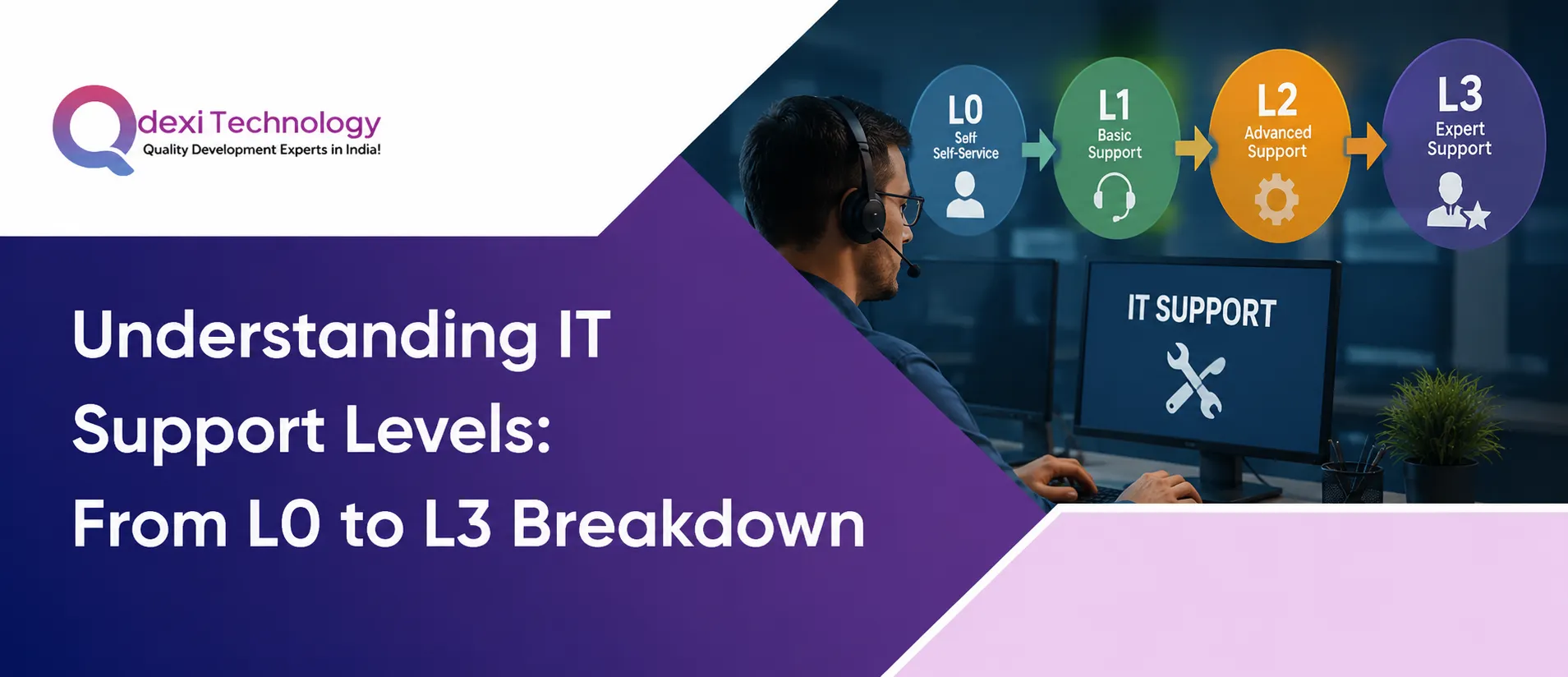
In today’s technology-driven business environment, IT support plays a critical role in keeping systems running smoothly. Whether it’s a small startup or a large enterprise, technical issues can disrupt productivity if not handled efficiently. To manage these issues effectively, organizations use structured IT Support Levels ranging from L0 to L3.
These support tiers help classify issues based on complexity and ensure that the right experts handle the right problems at the right time. Let’s break down how each level works and why it matters in modern IT operations.
What Are IT Support Levels?
IT Support Levels refer to a tiered system used by IT teams to handle technical issues. Instead of assigning all problems to a single team, issues are categorized based on difficulty and urgency.
Known as L1, L2, and L3 Support, this methodical approach occasionally incorporates an L0 self-service layer. Each level has different responsibilities, tools, and skill requirements.
The goal is simple: resolve issues faster, improve efficiency, and reduce downtime.
L0 Support: Self-Service Layer
Before we move into technical support tiers, many organizations implement L0 support, which is a self-service layer.
L0 includes:
- FAQs and knowledge bases
- Chatbots
- Automated troubleshooting guides
- User manuals and documentation
This level allows users to solve basic issues without contacting support teams. It reduces workload on IT teams and speeds up resolution for simple problems.
L1 Support: First Line of IT Help Desk
L1 is the first human interaction point in IT support. It is often handled by L1/L2 helpdesk support services, where L1 focuses on basic troubleshooting.
Responsibilities of L1 Support:
- Password resets
- Basic network issues
- Software installation support
- Ticket logging and categorization
- Handling common user queries
L1 support acts as a filter, resolving simple issues and escalating complex ones to higher levels.
Professionals in this tier rely heavily on IT Help Desk Support Software to track tickets, manage requests, and communicate with users efficiently.
L2 Support: Technical Problem Solvers
When issues cannot be resolved by L1, they are escalated to L2 support. This team handles more technical and complex problems.
IT Support Skills (L1 vs L2)
Compared to L1, L2 technicians have deeper technical knowledge and troubleshooting expertise.
Responsibilities of L2 Support:
- Advanced troubleshooting
- System configuration issues
- Application errors
- Network diagnostics
- Server-related support tasks
L2 teams analyze problems in detail and often collaborate with L3 experts when needed. They are essential to preserving the stability of the system.
This level is a core part of IT Support Tiers, ensuring that mid-level issues are resolved efficiently without overloading senior engineers.
L3 Support: Expert-Level Assistance
L3 is the highest level of IT support. These professionals are highly skilled engineers or system architects who handle critical and complex issues.
Responsibilities of L3 Support:
- Bug fixing in software or applications
- System architecture issues
- Security vulnerabilities
- Infrastructure failures
- Advanced technical troubleshooting
L3 teams often work closely with development teams and vendors to resolve deep-rooted technical problems.
This level is essential for ensuring long-term system reliability and performance.
L1, L2 & L3 Support Breakdown
The combined structure of L1, L2 & L3 Support ensures smooth IT operations.
Here’s how the flow works:
- L1 handles basic issues
- L2 manages technical escalations
- L3 resolves complex system-level problems
This structured approach helps organizations improve efficiency and reduce resolution time.
L1 L2 L3 IT Support Levels in Real Business Environments
In real-world IT environments, businesses rely heavily on L1 L2 L3 IT Support Levels to manage daily operations.
For example:
- Employees report issues to L1 helpdesk
- L1 resolves or escalates based on complexity
- L2 investigates technical problems
- L3 handles system-wide or critical failures
This workflow ensures that no issue is left unresolved and that experts handle tasks based on their skill level.
Importance of IT L1, L2 and L3 Support Services
IT L1, L2 and L3 Support Services are essential for maintaining business continuity.
Benefits include:
- Faster issue resolution
- Improved system uptime
- Better resource allocation
- Reduced operational costs
- Enhanced user satisfaction
By dividing responsibilities across different levels, organizations ensure smoother IT operations.
Role of IT Help Desk Support Software
Modern IT teams rely on IT Help Desk Support Software to manage support requests efficiently.
These tools help with:
- Ticket tracking
- Automated routing
- SLA management
- Reporting and analytics
- Communication between teams
Such software ensures that issues are assigned to the right support level quickly and efficiently.
L1 vs L2 Support: Key Differences
Understanding IT Support Skills (L1 vs L2) helps clarify how these roles differ:
- L1 focuses on basic troubleshooting and user support
- L2 handles advanced technical issues and system analysis
- L1 requires general IT knowledge
- L2 requires deeper technical expertise
Both levels work together to ensure smooth IT operations.
Challenges in IT Support Tiers
While the tiered system is effective, it also comes with challenges:
- Miscommunication between support levels
- Delayed escalations
- Overloaded L2 or L3 teams
- Incomplete issue documentation
Proper training and efficient tools help reduce these challenges.
Future of IT Support Levels
The future of IT support is becoming more automated and AI-driven. Emerging trends include:
- AI-powered helpdesk systems
- Self-healing IT environments
- Predictive issue detection
- Chatbot-based L0 support
These advancements will further improve efficiency across all IT Support Levels.
Conclusion
Understanding IT support levels is essential for efficient IT operations in any organization. From L0 self-service tools to advanced L3 engineering support, each level plays a vital role in maintaining system performance and user satisfaction.
The structured approach of L1, L2 & L3 Support, combined with modern IT Help Desk Support Software, ensures faster resolutions and better service delivery. Whether it’s basic troubleshooting or complex system failures, IT L1, L2 and L3 Support Services provide a reliable framework for handling all technical challenges effectively. By clearly defining l1, l2, l3 support responsibilities, businesses can improve productivity, reduce downtime, and build a stronger IT infrastructure for the future.